Choosing a Single Jersey fabric manufacturer in China involves more than comparing prices or browsing polished product photos. Buyers need to understand how a supplier handles yarn selection, knitting, dyeing, finishing, and quality checks. These details influence fabric weight, stretch, surface feel, and color consistency. They also affect how reliably a fabric performs across repeated production runs.
A small swatch can look excellent. Bulk fabric may behave differently. That gap deserves attention. This guide introduces manufacturers and explains practical points to check before requesting a quotation. Consider asking for specifications such as fiber composition, GSM, usable width, shrinkage, and colorfastness. Confirm minimum order quantities, sample costs, production timelines, and inspection procedures in writing. If sustainability or traceability matters to your project, ask what supporting records the supplier can provide rather than relying on broad claims. Clear answers are useful evidence; vague assurances are not.
The companies discussed should be assessed against your own product needs, since a supplier suited to basic T-shirts may not fit a premium or performance-focused line. Request a representative sample, wash it, and compare its dimensions and hand feel with your requirements. Check how the supplier responds to technical questions, too. Responsiveness matters, but it cannot replace documented specifications. No shortlist is perfect. Manufacturing capacity and service can vary by order, season, and product. Treat this guide as a starting point for careful evaluation, not a substitute for samples, direct discussions, and independent verification.
Single jersey is a weft-knit fabric formed from one set of needles. Its face shows neat vertical “V” loops; the reverse has softer horizontal arcs. This construction makes the fabric light, flexible, and often prone to curling at the edges. It is commonly made from cotton, polyester, or blended yarns. Textile Exchange’s Materials Market Report 2024 estimates that global fiber production reached 124 million tonnes in 2023, with polyester accounting for about 57%. The figures show why mills offer many fiber options, but they do not indicate which yarn will suit a particular garment.
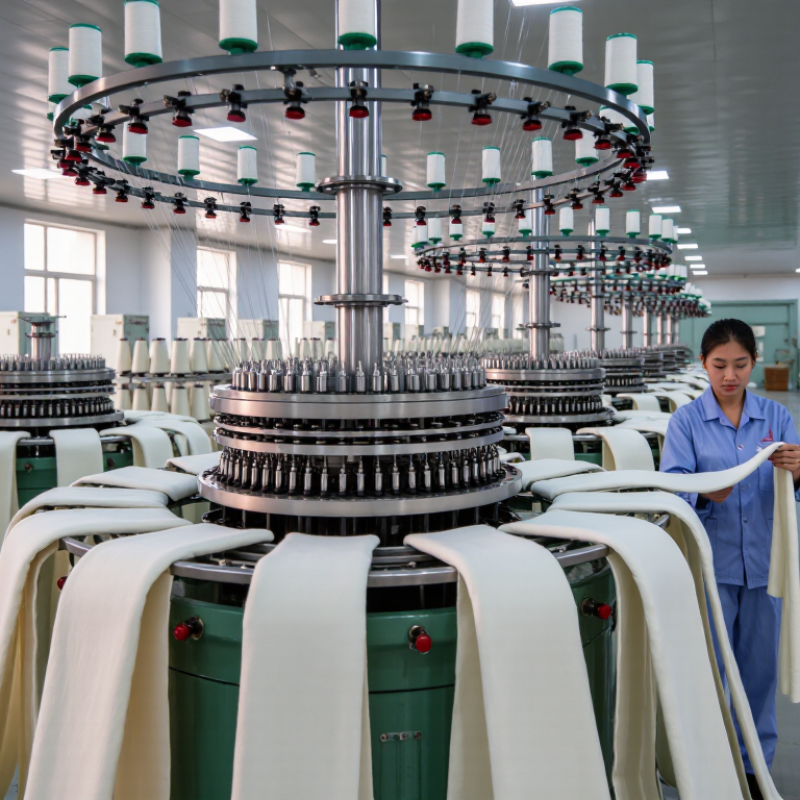
Production begins when yarn feeds into a circular knitting machine. Needles catch the yarn and draw new loops through existing ones, building a continuous tube of fabric. Machine gauge and stitch length affect the surface, stretch, and weight. After knitting, the fabric is relaxed, cleaned, dyed, and finished; synthetic blends may also be heat-set. The part teams sometimes underestimate is relaxation. A roll can change width or length after washing, even when it looked stable on the inspection table. A mill’s sample should therefore be checked against the intended garment and care process.
Tips: Request fabric weight in GSM, width, shrinkage, and spirality results. Wash a small sample before approving bulk production. Feel the reverse, too—it can reveal a rough finish.
| Topic | Typical Data or Description | What Buyers Should Check |
|---|---|---|
| Fabric structure | A weft-knit fabric formed from a single set of needles. The face typically shows vertical “V” stitches; the reverse has a more textured, looped appearance. | Confirm the requested construction and inspect both fabric sides. Single jersey commonly curls at the cut edges because of its knitted structure. |
| Common fiber content | Cotton, polyester, viscose or modal, and blends such as cotton/polyester are commonly used. Elastane may be added where extra stretch and recovery are required. | Specify fiber percentages and applicable test methods. Do not rely on a “soft” or “stretch” description as a substitute for a composition specification. |
| Typical fabric weight | Common apparel orders often fall around 120–280 g/m². Lightweight, midweight, and heavier options are available; the suitable range depends on yarn, stitch length, and end use. | State a target GSM and acceptable tolerance. Verify weight using a recognized method, such as ISO 3801 where applicable, and test samples after the agreed finishing process. |
| Fabric width | Finished usable width varies by machine, tubular or open-width processing, and finishing. Apparel fabrics are commonly supplied in widths around 150–200 cm, but this is not a universal standard. | Clarify whether the quoted width is tubular, open-width, or usable width after finishing. Record the measurement method and permitted variation. |
| Knitting equipment | Single jersey is commonly produced on circular knitting machines. Machine diameter, needle gauge, yarn count, and stitch length influence the fabric’s appearance and properties. | Ask whether the mill can reproduce the approved sample on its intended production equipment. Machine settings should be validated against the required fabric specification. |
| How it is made | A typical sequence is yarn preparation → circular knitting → fabric inspection → scouring or washing → dyeing or printing, if required → finishing and setting → final inspection and packing. | Confirm which steps are performed in-house or by approved subcontractors, and agree on inspection checkpoints and traceability for each production lot. |
| Finishing options | Finishing may include washing, compacting, heat setting for suitable fibers, softening, enzyme treatment, or printing. The correct process depends on fiber content and intended performance. | Approve a finished sample, not only greige fabric. Check dimensional change, hand feel, shade, spirality, and surface appearance after the specified treatment. |
| Performance checks | Relevant checks can include mass per unit area, width, dimensional change after washing, colorfastness, pilling, bursting strength, and skew or spirality. | Agree on test methods, conditioning, sample size, and acceptance limits before production. ISO or AATCC methods may be specified according to the buyer’s requirements. |
| Supplier evaluation | Assess relevant knitting and finishing capability, sample consistency, quality procedures, production capacity, lead-time planning, and experience with the requested fiber and finish. | Request a specification sheet, production sample, test reports where relevant, quality-control procedure, and written confirmation of capacity and delivery terms. Evaluate suppliers against the same criteria. |
| Best suited for | T-shirts, tops, casualwear, underwear, and other garments where a soft, flexible, lightweight-to-midweight knit is appropriate. | Match the fabric weight, fiber, stretch, opacity, and finishing to the garment design and care requirements; construction alone does not determine performance. |
Note: Figures are general sourcing guidance, not universal specifications. Actual fabric properties vary by yarn, machine settings, finishing, and supplier.